

Over the past several years, Texas Urban Council districts have focused on strengthening the foundational literacy and mathematics skills that prepare students for success in high school and beyond. Spring 2026 STAAR results for grades 3-8 suggest those efforts are continuing to translate into stronger outcomes for students.
Every TUC district improved from 2024 on both Reading and Math assessments across grades 3-8, reflecting broad-based progress across urban school systems serving some of Texas’ highest-need student populations. Since 2025, the percentage of students meeting grade-level standards increased by two percentage points in Reading and three percentage points in Math both of which exceeds the state’s stable performance in Reading and one-point gain in math. Across TUC districts, the percentage of students meeting grade-level standards in Reading increased by six percentage points since 2024, and seven percentage points in Math over the same period.
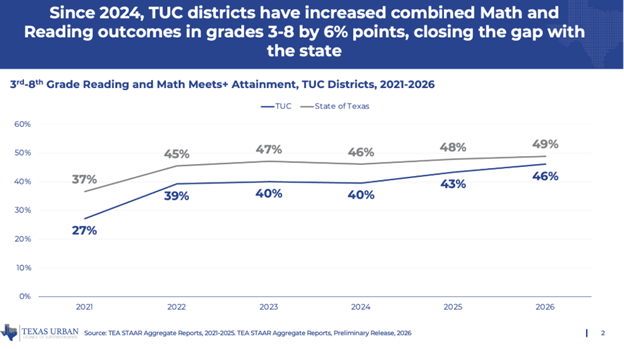
These results build on the momentum highlighted in recent End-of-Course assessment outcomes and suggest that districts are strengthening achievement throughout the academic pipeline, from elementary school through high school.
Shared early literacy efforts helped increase third grade reading proficiency in TUC, outpacing statewide growth
Among the encouraging results, third-grade reading stands out as one of the most important indicators of long-term student success.
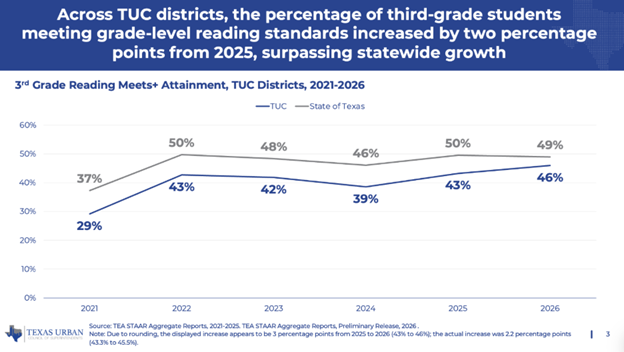
Across TUC districts, the percentage of third-grade students meeting grade-level reading standards increased by two percentage points from 2025 and seven percentage points since 2024. This year-over-year growth surpassed the state, which saw no growth since 2025. Several districts posted particularly strong gains over the past two years, including Dallas ISD, Fort Worth ISD, Garland ISD, Houston ISD, and Ysleta ISD.
For urban districts in TUC, that two percentage point gain in one year represents nearly 1,000 additional third-grade students reading on grade level compared to last year.
These gains reflect a sustained focus across TUC districts on strengthening academic foundations for early learners. Since 2021, district leaders have worked together through the Texas Urban Council to set shared goals and align efforts around improving outcomes for students, including ensuring more students are reading on grade level by the end of third grade. That focus is rooted in a strong body of research showing that third-grade reading proficiency is one of the strongest predictors of long-term success, including higher rates of educational attainment, stronger workforce outcomes, and greater economic mobility. As more students read on grade level by the end of third grade, they are building the literacy foundation needed to succeed in later grades, access rigorous coursework, and pursue a wide range of future opportunities.
“Third-grade reading is one of the most important milestones in a student’s academic journey. These results show that a sustained focus on foundational literacy is helping more students build the skills they need for long-term success,” said Dr. Anthony Mays, TUC Chair and Superintendent of Alief ISD.
The gains in third-grade reading are part of a broader literacy story across TUC districts. Ten out of eleven TUC districts improved in fifth-grade and seventh-grade reading from 2025 to 2026, reflecting continued progress as students move through the academic pipeline. In fifth grade, Fort Worth ISD and Corpus Christi ISD both grew the number of students meeting grade level standards by at least four percentage points. Strong gains were also evident in middle school, where Fort Worth ISD, Houston ISD, Aldine ISD, and Garland ISD each increased seventh grade reading achievement by at least four percentage points from 2025 to 2026. In eighth grade, Ysleta ISD and Houston ISD each posted gains of five percentage points or more. Together, these results suggest that literacy improvements are extending beyond the early grades and helping more students build the reading skills needed for long-term academic success.
Math achievement continues to climb across Texas Urban Council districts
Mathematics results also demonstrated encouraging momentum across TUC districts.
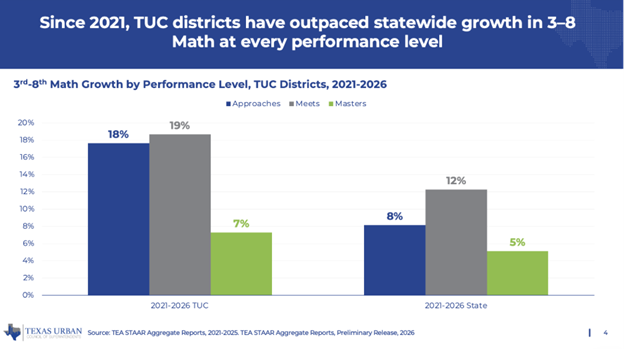
The progress in mathematics was not limited to a handful of districts or student groups. Every TUC district improved math achievement between 2024 and 2026, and districts collectively saw gains across Approaches, Meets, and Masters performance levels from 2025 to 2026. These results suggest that more students are building foundational math skills, meeting grade-level expectations, and reaching advanced levels of achievement.
“These gains reflect years of intentional work to strengthen instruction, support teachers, and implement high-quality instructional materials that ensure students engage with rigorous grade-level mathematics every day. It is encouraging to see more students building the mathematical foundation they need to succeed in Algebra I, advanced coursework, and future opportunities. The progress across districts and performance levels demonstrates what is possible when strong curriculum, effective teaching, and sustained support for educators come together on behalf of students,” said Mohammed Choudhury, Deputy Superintendent of Curriculum and Instruction at Fort Worth ISD.
As districts continue strengthening mathematics instruction, more students are building the skills necessary to access college, career, and military pathways after graduation.
Stronger foundations today support stronger outcomes tomorrow
The spring 2026 STAAR results tell a consistent story across Texas Urban Council districts: when districts align around shared goals, students benefit.
Since 2021, TUC districts have worked together to establish common priorities, share effective practices, and hold one another accountable for improving outcomes for students. The progress reflected in the 2026 STAAR results demonstrates what is possible when districts collaborate around a shared vision for student success.
These results also align with the broader trends highlighted in the Texas Urban Council’s 2026 Annual Report, which documented accelerated academic recovery and continued progress across multiple measures of student achievement.
To sustain this momentum and continue improving outcomes for students, TUC districts have established a shared goal that by 2030, every student in a Texas Urban Council district will attend an A, B, or C rated campus. As districts continue to focus on instructional quality, educator effectiveness, and collaborative implementation strategies, the 2026 results provide another encouraging signal that collective action is translating into stronger outcomes for students across Texas urban schools.