

Last month, Michael Casserly with the Council for the Great City Schools penned an op-ed for the Dallas Morning News with an unmistakable headline: “Urban schools are winning.” In the time since Casserly’s publication, new outcomes data, combined with a deeper analysis of existing data, have underscored that his message is especially true for member districts of the Texas Urban Council.
TUC districts are ensuring more students enter college, career and the military ready
Since the passage of House Bill 3 in 2019, Texas has awarded public school systems with outcomes-based funding for every student that demonstrates college, career and military readiness (or CCMR), with more funding awarded for supporting students in special education or experiencing economic disadvantage.
But in order to qualify, students must not only pass a college readiness assessment (such as the SAT, ACT, or Texas Success Initiative Assessment) but take specific actions aligned to future success, such as enroll in college, earn a workforce certificate, or enlist in the armed forces.
This distinguishes the outcomes-bonus funding definition of college, career and military readiness from the one used in our state’s accountability system, which requires only that students meet one of a list of college, career and military readiness benchmarks that range from completing three hours of dual credit to the attainment of an associate degree in high school.
For the past several years, TUC member districts have collaborated to design and implement CCMR strategies aligned to this more rigorous standard. And recently released data from the Texas Education Agency demonstrates that these efforts are having their intended effect.
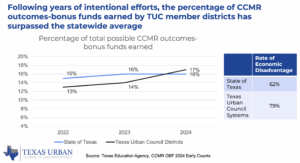
Specifically, the percentage of total possible CCMR outcomes-bonus funds earned by TUC member districts has surpassed the statewide average for the first time since they began to be awarded. This is especially notable given that Texas Urban Council districts, collectively, serve a student population experiencing economic disadvantage at a rate significantly higher than the state as a whole.
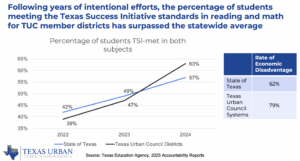
These findings are reinforced by recent accountability data, which demonstrate that more students are meeting Texas Success Initiative standards in both reading and math. While not as strict as the one needed to earn outcomes-bonus funding, meeting this threshold ensures students will not be required to take costly remedial coursework in college, which in turn increases the likelihood they will persist to a degree or other credential.
TUC districts are accelerating learning for students who need additional support
Across the state of Texas, only one-in-five third graders who are unable to read on grade level are caught back up by sixth grade – and this proportion is even smaller for the subject of math.
But the events of the COVID-19 pandemic, in which many students fell behind grade level due to the disruption of in-person instruction, have made learning acceleration an increasingly important topic for our school systems. That’s why, as part of its 2023 “Refresh” of the accountability system, the Texas Education Agency began rewarding school systems for supporting students who grew from “not meeting” grade level standards to at least approaching, if not meeting, them.
Now, recently released state accountability data, made newly available after several years of delay due to litigation, allows us to dive into this incredibly important metric for the first time. And what we see is that, in both reading and math, the percentage of formerly struggling students now approaching state standards in Texas Urban Council school systems is meeting or exceeding statewide averages.
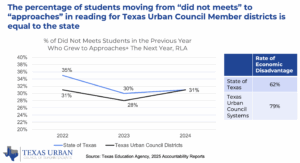
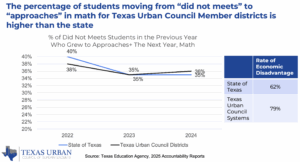
“Looking at these data, I couldn’t be prouder of our member school systems,” said Alief ISD Superintendent and TUC Chair Anthony Mays. “By working together to collaborate on significant topics such as learning acceleration and college, career and military readiness, our leaders are producing real results for the students they serve in spite of the significant challenges they face.”